
NEW TERM WEAPON: S&S
- May 10
- 3 min read
As a fresh term commences, we embrace enhanced guidance as our foundational stepping stone on our journey towards mastering the legacy of weaponry wielded by history's illustrious warriors.

Hi Temple Fam! it's a plesure to meet you all in this new term, and thrilled to see your enthusiasm for this new weapon form. S&S, as part of our autumn term curriculum, is the focal point of our study in the "Forms Class." Our goal is to create a conducive learning environment for everyone and provide additional guidance to address common issues that have arisen so far. This will help all of you better grasp the form and acquire a new skill on your KungFu journey.
After three weeks of summarizing our learn, we have identified that the primary challenges currently revolve around stance work.
The stance work in the Shield and Blade form primarily encompasses:
1. Traditional squat-style stances

2. As well as standing-style stance work, also known as walking-style , which facilitate transitions in the form's movements.

**Challenge 1: Transitioning between traditional squat-stance**
To address this issue, we recommend standing in front of a mirror and repeatedly practicing the entire footwork sequence to gain a deeper understanding of the logical connections between different steps. For example, consider transitioning from a Gongbu (lunge stance (one leg bent, one leg straight) to another Gongbu, with a transitional step being a Mabu (horse stance).
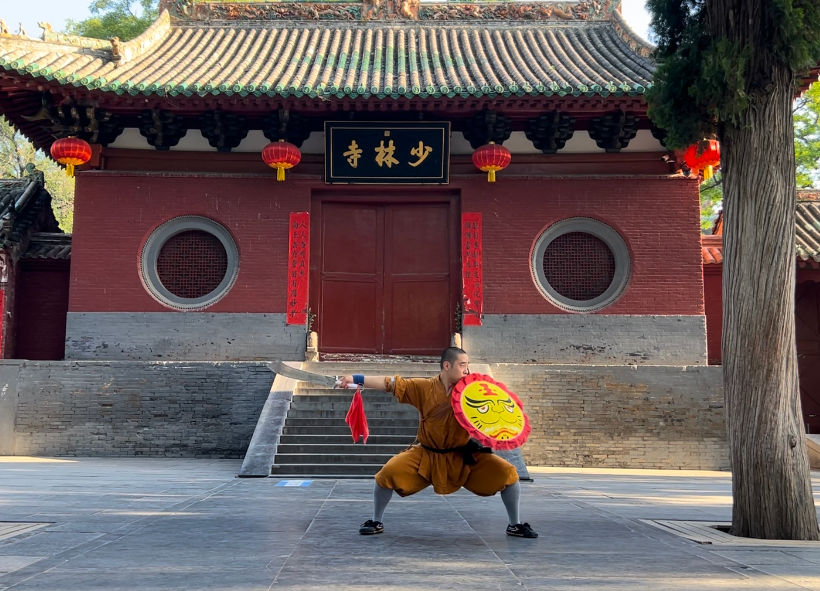

This is because the MuBu (horse stance's) characteristics provide the squatting posture of both legs, preparing for the transition to the lunge stance in the opposite direction. This logical connection determines the direction of the movement, allowing for a powerful and stable transition in that direction.
We suggest focusing specifically on the transition from a horse stance to a lunge stance after mastering these step transitions. Practicing these transitions will be the fundamental logic for the entire form learning process, ensuring that movements are gradually built up from simple to complex. If a particular step feels less smooth, it's advisable to concentrate on targeted practice for that step. The looping GIF images provided in the program can be a helpful reference. Additionally, placing a mirror in front of you also allows for real-time evaluation and correction of your movements. Crucially, to share any further issues encountered during practice in the forum and group discussions, as this will provide you with team support and assistance.

**Challenge 2: Transitional stance for Form AKA Walk style stance**
Unlike traditional squat-style footwork, these footwork patterns resemble walking and require smooth overall movement. When performing standing-style footwork, you can reference a normal walking posture to ensure the movement's reasonableness. Furthermore, special attention is required regarding the coordination between footwork and the hands and weapon. For instance, when thrusting with the sword, the shield should be pulled back in conjunction with the body to provide protection. As the sword is retracted and prepared for the next move, the shield should be positioned in front of the sword for the next attack or to block the opponent's attack.
This coordination can be understood by imagining sparring with an opponent. When the opponent blocks your attack, you need to push the shield forward while retracting the sword to effectively fend off the opponent's strike.

Have you encountered any issues while practicing with this weapon? Feel free to leave a comment on this blog post, and we will address them for you in the future.


Comments